For one day each spring, something shifts at Alma College.
Classes pause. Syllabi wait. And students take the front of the room.
Kapp Honors Day is not just a campus tradition — it is a launch point. The research presented on this day has strengthened graduate school applications, been shared at professional conferences and, in some cases, been published in academic journals. What begins as a classroom idea often evolves into work with real academic and professional impact.
Honors Day makes that work visible.
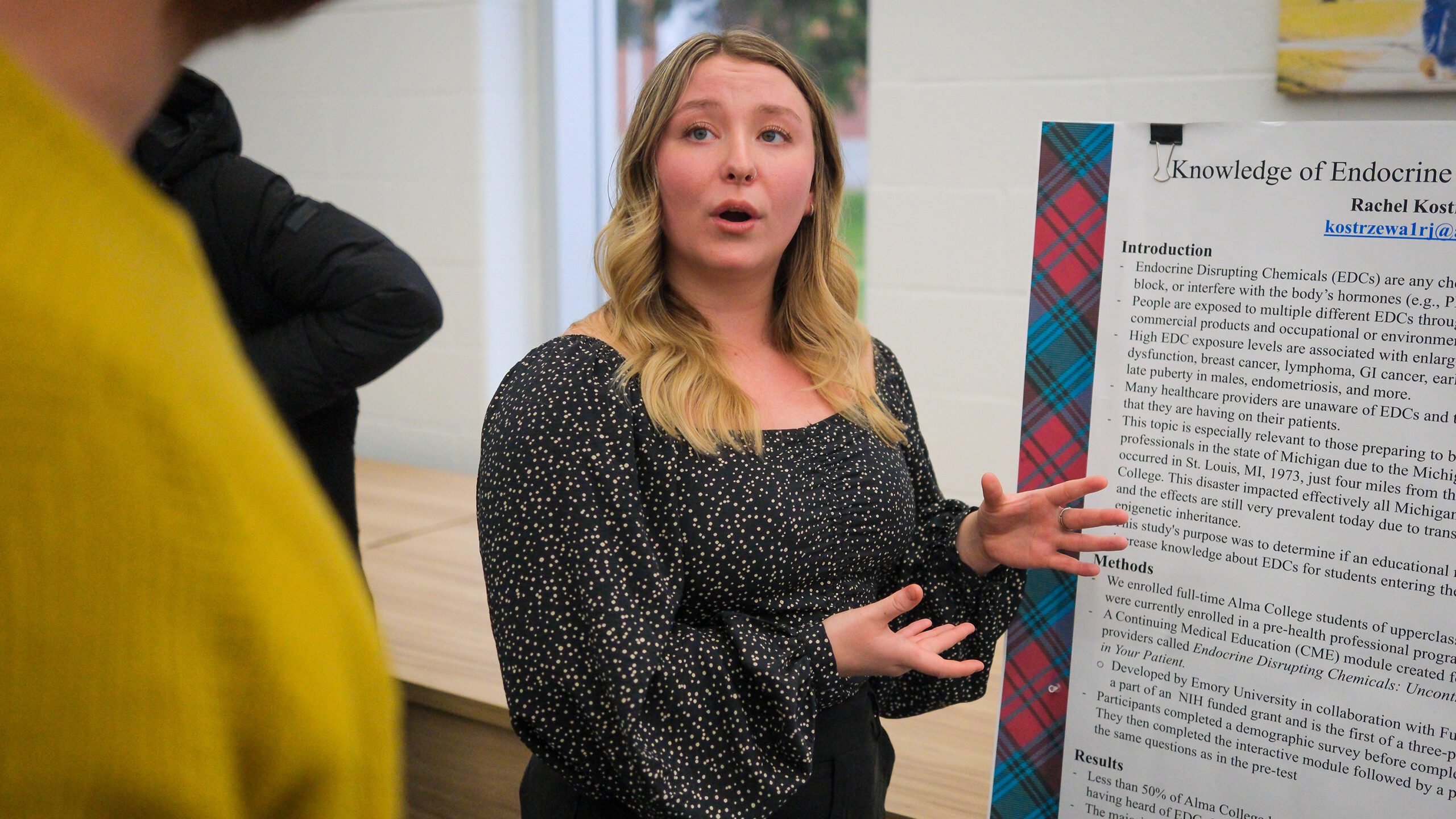
Laboratories, studios and libraries empty into presentation rooms. Faculty sit beside first-year students. Peers ask questions. Conversations stretch into hallways. The work speaks — and the campus listens.
A Celebration of Undergraduate Scholarship
Established to celebrate scholarly and creative activity in the liberal arts, Honors Day invites students from every discipline to present original research and creative work.
The format is intentionally broad:
- Oral research presentations
- Poster sessions
- Artistic and dance performances
- Interdisciplinary projects
- Independent studies and faculty-mentored inquiry
The common thread is ownership. These are not summaries of textbook chapters. They are sustained investigations shaped by curiosity, challenged by faculty mentors and refined through revision.
At Alma, undergraduate scholarship is not supplemental. It is expected.
That spirit is reflected in the wide range of work students present each year. This year’s projects include:
How road salt affects our environment
Trevor Grandy’s project, Effect of Road Salt Formulation on Lemna minor Toxicity, investigates how different road deicing salts affect the health of Lemna minor, a small freshwater plant important to aquatic ecosystems. Using 7-day toxicity assays, the study compared the effects of four common deicers — sodium chloride (NaCl), MELT Beet Deicer, Safe Step, and MELT calcium magnesium acetate (CMA) — by measuring plant growth through frond number and dry mass. Grandy, an environmental science major from Saginaw, wrote that results show that all formulations negatively affected plant growth, and some alternative products marketed as environmentally friendly caused harmful effects at lower concentrations than traditional NaCl.
Does vitamin D improve sleep?
A project by three students; Salma Laraichi, Jhonny Cedillos and Joscelyn Marriott, examines whether vitamin D supplementation influences circadian rhythms, sleep quality and mood in healthy young adults. Forty-five participants completed baseline measurements before taking 4000 IU of vitamin D daily for four weeks, after which their sleep patterns, mood and circadian rhythm parameters were reassessed. The study found significant improvements in subjective sleep quality, including reduced time needed to fall asleep and fewer sleep disturbances. Although depression scores showed some improvement, the change was not statistically significant, and circadian rhythm strength appeared to be influenced more by seasonal factors than supplementation.
Gender dynamics in ballet history
Paulina Rivet’s project, Exploring Feminine Leadership in the Ballet Industry, combines historical research with original choreography to examine gender dynamics within classical ballet. Noting that most ballet choreographers have historically been male despite the predominance of female dancers, Rivet, of Laingsburg, created a ballet piece choreographed by a woman for an all-female cast. Drawing inspiration from influential ballerinas such as Marie Taglioni, Fanny Cerrito, Lucile Grahn, Anna Pavlova and Carlotta Grisi, her work questions traditional narratives that center female dancers around male leads. Through performances at multiple dance events, Rivet’s choreography highlights relationships among female dancers and celebrates female creative leadership within the art form.
Recognizing Excellence
Outstanding presentations are recognized each year with the Ronald O. Kapp Honors Day Prize, awarded in the humanities, social sciences and natural sciences. Named for longtime professor and academic leader Ronald O. Kapp, the prize honors work that reflects intellectual rigor, originality and depth.
But the true measure of Honors Day is not a single award.
It is the expectation that undergraduates are capable of serious scholarship — and the institutional commitment to giving them a platform.
Students are not waiting until graduate school to conduct meaningful research. They are already building the credentials, confidence and intellectual habits that carry them there.
Ready to take the front of the room at Honors Day? Learn how Alma College supports undergraduate research and academic exploration across every discipline.