
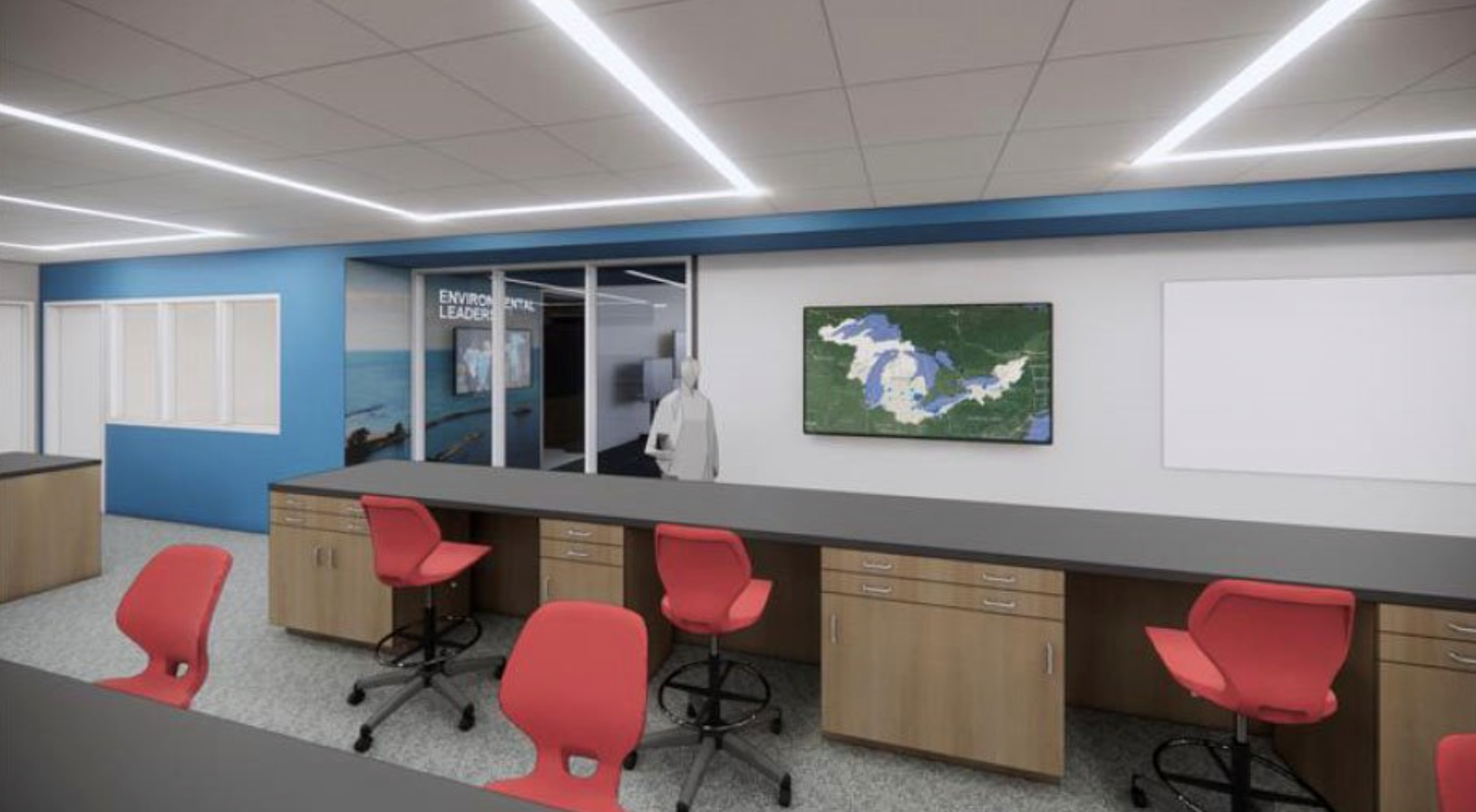
The new GLWI lab will be opening in August 2026.
Protecting the Great Lakes doesn’t start at the shoreline.
It starts upstream — in the rivers, tributaries, and communities that feed into them.
This fall, that upstream work will have a new home at Alma College.
The Great Lakes Watershed Institute (GLWI) is moving into a newly renovated, state-of-the-art laboratory space designed specifically to support student research, hands-on learning, and regional partnerships focused on researching our freshwater systems. Construction begins this spring, with the renovated lab scheduled to open in time for the start of the academic year.
Located in Room 224, adjacent to the upper level of the Dow Digital Commons (formerly the microbiology lab), the new GLWI space will feature 16 student research stations and flexible teaching space designed to integrate coursework and active research. The new space will be opening in August 2026.
For students interested in environmental science, biology, or sustainability-focused careers, the space represents something bigger than a new classroom: it represents access.
A Lab Built for Student Research
The GLWI focuses on the environmental integrity of the Great Lakes by studying the watersheds that flow into them. Many ecological challenges affecting the Great Lakes begin far upstream. By concentrating on watershed-level science, Alma students are able to engage with real-world data and real-world partners in order to provide information to the mostly rural communities that are heavily dependent on these waterways.
The new lab will support research in areas such as geochemistry, microbiology, toxicology, and related fields. Just as important, it will allow research findings to move directly into the classroom.
At Alma, students don’t just read about environmental issues — they work on them.
Courses regularly incorporate current research data into projects that connect students with local municipalities, environmental agencies, and community stakeholders. Students analyze data, evaluate impacts, and present findings in professional settings. The new GLWI lab strengthens that theory-into-practice model by giving students a dedicated space to conduct and interpret research together.
Paid Research. Real Outcomes.
For prospective students, one of the most compelling aspects of the GLWI is opportunity.
The Institute supports paid summer research and internship experiences, including stipends, housing, and conference travel support. Students work alongside faculty on active research projects and regularly present their findings at national and international conferences.
In recent years, Alma students have:
- Co-authored peer-reviewed publications
- Presented at major scientific conferences
- Earned competitive internships with environmental consulting firms and state agencies
- Gained admission to respected graduate programs in environmental science, public policy, and law
These experiences build résumés — and they also build confidence. Students graduate not only with knowledge, but with professional experience, presentations, and published research. GLWI students have moved to graduate school at institutions including the University of Michigan, Indiana University, the University of Miami (Fla.), Baylor University and Loyola University.
Building Partnerships — and Pathways
The GLWI also serves as a hub for collaboration.
The Institute is strengthening partnerships with two-year colleges to expand access to research-based learning and create clearer transfer pathways for students interested in environmental fields. It is also developing STEM outreach opportunities for middle and high school students, introducing them to watershed science and hands-on investigation early in their academic journeys.
By connecting K–12 students, community colleges, and Alma undergraduates, the GLWI is cultivating a pipeline of students prepared to engage with freshwater science and sustainability challenges.
For prospective Scots, that means joining a growing network — one rooted in research, collaboration, and regional impact.