
Moot Court builds confidence, critical thinkers, and future advocates.
When Assistant Professor of Political Science Ben Taylor arrived at Alma College two years ago, the Moot Court program was little more than an idea in a job description. Today, it’s a growing academic community — one that draws students from across disciplines, challenges them to think critically under pressure, and prepares them for lives of leadership in and beyond the law.
Moot Court simulates oral argument before the Supreme Court,
Taylor explained. Students are arguing complex legal issues while being interrupted by judges who can ask them to clarify their position or demonstrate their understanding. It’s not just a prepared speech — it’s a dialogue about the law.
That conversational rigor, Taylor said, is what sets Moot Court apart from other academic competitions. It demands deep comprehension and quick thinking,
he added. Students must argue both sides of a case, not as individuals with opinions, but as interpreters of the law. That process—learning to see through another perspective—is the essence of critical thinking.
Building from the ground up
Alma’s Moot Court program launched in 2023 with a class of 25 students, most of whom had never heard of the activity before. By the end of the term, 14 remained — and from that small group came the program’s first regional competitors. Now in its second year, the class has grown in both size and experience. Five returning students, including team captains Jackson Eelbode and Stephanie Rauch, spent the summer reading cases, preparing arguments, and mentoring new participants.
That foreknowledge has made all the difference,
Taylor said. They came back ready to lead, and that experience helps integrate new students much more smoothly.
The team’s calendar this year reflects that growth: early-season tournaments in Long Beach, Calif., and Ann Arbor, followed by two regional competitions — including one that Alma hosted on campus in the fall.
Hosting our own tournament was a milestone,
Taylor said. We welcomed teams from a dozen schools, including several from across the country, and nearly 30 of our judges were Alma alumni. It was a great opportunity to connect our students and alumni through shared intellectual engagement.

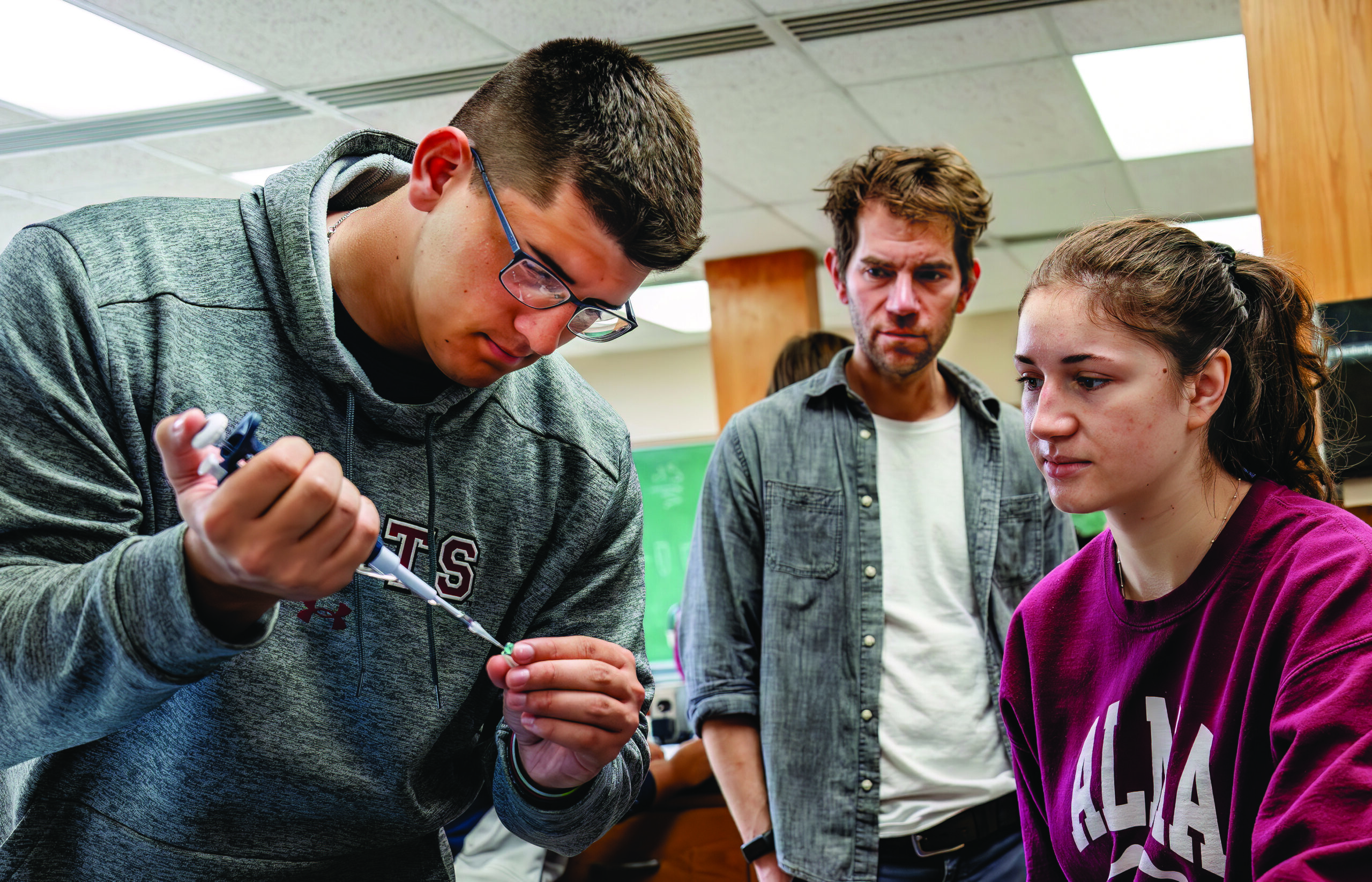
Assistant Professor of Political Science Ben Taylor instructs Moot Court participants Natalie Krause and
Stella Lampert at an early-season tournament in Long Beach, Calif.
Confidence in the courtroom
For Eelbode, a senior political science major, Moot Court began as a way to earn upper-level credits. It quickly became something much more.
You gain a lot of knowledge of the law through close study,
he said. But beyond that, it changes how you understand current events. You start to see how laws are interpreted, how they impact people, and what rights individuals actually have.
Those lessons, he adds, connect directly to Alma’s mission.
Moot Court helps you think critically and live responsibly. Every person should understand their rights — and this program helps you do that.
Eelbode says his experience has also opened new doors. I just signed up for the LSAT,
he noted. I wouldn’t have considered law school before Moot Court, but I realized how much I enjoy it — not just the competition, but the way it makes you think.
Finding her voice
Rauch, also a senior and co-captain, echoes that sentiment.
I enjoy composing arguments and cutting through the facts to the main issues,
she said. But the presentation — communicating clearly and concisely — was the hardest part for me at first.
Over time, those challenges became opportunities for growth. The vocabulary and precision required in Moot Court have changed how I think and speak,
Rauch explained. Before, I was nervous to present or ask questions. Now, I don’t hesitate to get up and speak — whether it’s in class, at a competition, or a job interview.
That transformation, Taylor said, is the true measure of success. It’s not just about winning tournaments. It’s about the quality of the students’ thinking — their ability to respond thoughtfully, to read deeply, to speak with confidence. Watching that growth happen is the most rewarding part.
One moment stands out for Taylor: watching Rauch and Eelbode advance to the second day of competition at Fitchburg State University, in Massachusetts, last year. It was the first time I got to see one of our teams move forward in real time,
he recalled. I probably fist-pumped. It was a big moment — not just for them, but for the entire program. It showed that Alma students can hold their own against much larger, more established teams.
As the program continues to expand, Taylor hopes it will remain a place where students discover not just how to argue well, but how to think well — about the law, about the world, and about themselves.
Moot Court,
he said, develops seriousness — a commitment to knowing something deeply and engaging with it honestly. That’s the heart of what a liberal arts education is all about.