
Widad Hajji
Class of 2027
Home Country: Morocco — Detroit, Michigan: Consulate General of Canada
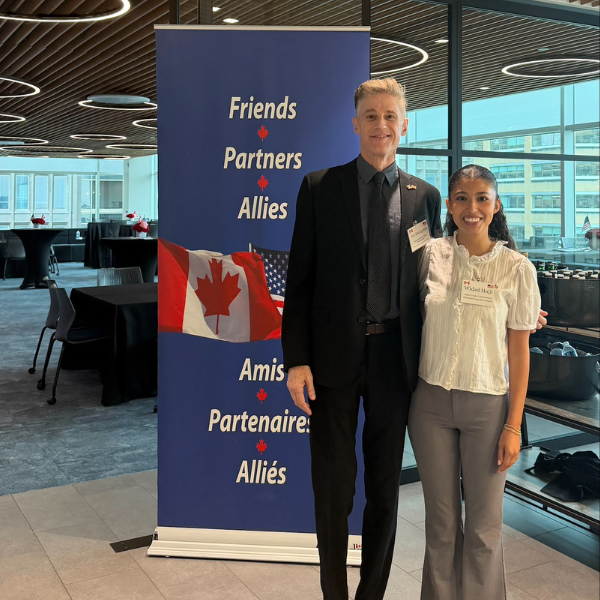
When I began my experience as a Junior Trade Commissioner Intern at the Consulate General of Canada in Detroit, I expected to learn more about international trade and diplomacy. I did not expect how much the experience would change the way I understand the relationship between public policy and everyday life. As a student studying international business and political science at Alma College, I had spent considerable time learning about institutions, markets, and international cooperation in the classroom. Through my 2026 P-GLOBAL experience, those ideas became real people, real decisions, and real consequences.
Detroit is a particularly meaningful place to study the relationship between Canada and the United States. The two countries share far more than a border. Businesses, workers, suppliers, and communities depend on connections that cross it every day. At the Consulate, I saw how trade policy can shape those connections, and how much work happens behind the scenes to maintain them. Discussions about tariffs, investment, and border infrastructure were no longer abstract topics from a textbook. They were issues that businesses and government representatives were actively trying to navigate.
One of the most memorable parts of my experience was participating in a walk across the Gordie Howe International Bridge before its opening. Standing on infrastructure designed to connect two countries made the purpose of cross-border cooperation tangible. A bridge is a physical structure, but it also represents years of planning, negotiation, and shared commitment. That experience helped me appreciate how international relationships are built through practical decisions as well as diplomatic conversations.
My responsibilities also gave me a more detailed understanding of the work of a trade office. I supported research, prepared briefing materials, worked with information in the team’s client relationship management system, and contributed to projects involving trade and investment. I researched agricultural sectors, helped track tariff-related developments, and gathered information to support events and outreach. These tasks taught me that good policy and effective diplomacy depend on accurate information, attention to detail, and the ability to communicate complex issues clearly. Even work that seems small can contribute to a larger effort when others rely on it to make decisions.
I was especially interested in seeing how the Consulate engaged with people outside government. Trade is often discussed as if it were only about agreements between countries, but businesses experience it through supply chains, costs, uncertainty, and opportunities to expand. My exposure to meetings and events, including activities connected to World Trade Day in Kentucky, showed me how diplomats help create conversations among government officials, business leaders, and regional partners. I began to understand economic diplomacy not simply as representing a country’s interests, but also as listening carefully and identifying areas where cooperation is possible.
This experience challenged me personally. Entering a professional diplomatic environment as a student meant learning unfamiliar terminology, asking thoughtful questions, and adapting to high expectations. At first, I sometimes worried about whether I knew enough to contribute. Over time, I became more comfortable taking initiative, checking facts, and recognizing that learning is part of doing meaningful work. I also learned to be more deliberate in how I write and speak, because a concise, well-supported briefing can be more useful than a long explanation.
As an international student with personal ties to more than one country, I have long been interested in how borders and government decisions affect people’s opportunities. My time at the Consulate gave that interest a clearer professional direction. It reinforced my desire to pursue graduate study in public policy and to build a career in economic diplomacy and international trade policy. I want to help reduce uncertainty and strengthen cooperation, particularly in regions where neighboring economies are deeply connected.
I am grateful that Alma College’s P-GLOBAL program helped make this experience part of my education. The value of the fellowship was not limited to what I learned about Canada–U.S. trade. It gave me the confidence to see myself in professional spaces where international decisions are discussed and shaped. I returned to my studies with better questions, stronger skills, and a clearer understanding of the kind of work I hope to do. Most importantly, I learned that international cooperation is not an abstract ideal. It is something people work to sustain, one conversation, one project, and one decision at a time.