
Isabelle Monroe
Class of 2027
Home Country: United States — Iceland and the Faroe Islands
As part of the Model UN Fellowship in Regional Enrichment (FIRE) program, I traveled to the Faroe Islands and Iceland from May 25- June 1, 2026. This experience provided an opportunity to explore international environmental issues, engage with professionals working in marine governance and climate policy, and experience the unique ecological and cultural environments of the North Atlantic region. As an Environmental Science major and an active Model UN participant, I was particularly interested in learning how countries approach shared environmental challenges and how scientific research, international cooperation, and public policy intersect.
The first part of the experience took place in Tórshavn, the capital of the Faroe Islands, where I attended the UArctic Congress and Ocean Connectivity Conference at the University of the Faroe Islands from May 26–28. The conference brought together researchers, scientists, policymakers, and students to discuss issues affecting Arctic and North Atlantic regions. There were many topics covered over the three days: ocean connectivity, ocean pollution, marine biodiversity, climate change, sustainable economic development, international cooperation, and Arctic governance. I had the opportunity to learn about the environmental and geopolitical challenges facing northern communities while hearing different perspectives on how these issues can be addressed through research, policy, and international collaboration. As someone who has participated in four United Nations Environment Assembly (UNEA) Model UN conferences, I especially appreciated being able to connect the international frameworks and policy discussions I had previously studied with the work of professionals addressing these issues firsthand.
On May 28, I had the amazing opportunity to participate in a Puffin Safari Boat Tour in the Faroe Islands. This was probably the most exciting part of the experience to me personally, because it allowed me to observe Atlantic puffins in their natural habitat. The boat excursion provided an opportunity to see the islands’ coastal landscapes, sea cliffs, and surrounding marine environments while learning more about the region’s wildlife. As an environmental science student potentially interested in pursuing animal-focused field research, this experience was particularly meaningful to me. It also gave me an opportunity to explore a non-typical ecosystem (tundra) and consider how species adapt to the environmental conditions of the North Atlantic.
On May 30, I participated in a guided Golden Circle and Blue Lagoon tour. Throughout the day, we visited several of Iceland’s most recognizable geological and natural attractions, including Þingvellir National Park, the Geysir geothermal area, Gullfoss Waterfall, and Kerið Crater. These locations provided firsthand examples of Iceland’s unique geological activity, including volcanic landscapes, geothermal features, and the movement of tectonic plates. The tour concluded with a visit to the Blue Lagoon, where I experienced one of Iceland’s most well-known geothermal attractions. Seeing these environments in person helped reinforce concepts I’ve learned in the classroom related to geology, geothermal resources, and the relationship between natural processes and human activity.
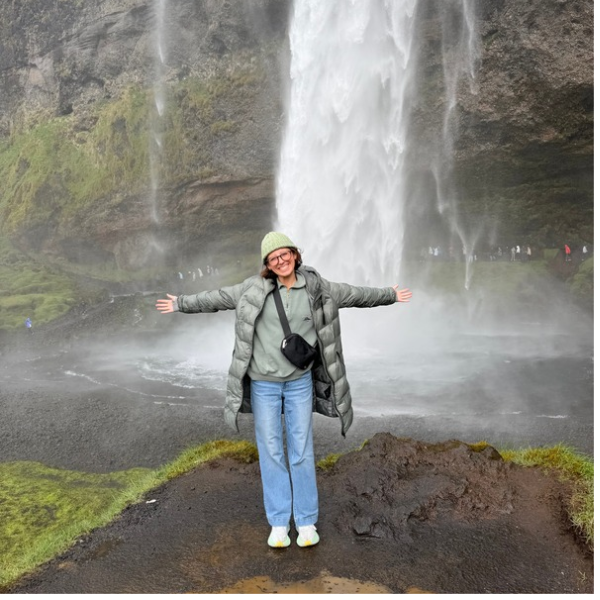
On May 31, I participated in another full-day guided tour– this time of Iceland’s South Coast. During the excursion, we visited Seljalandsfoss and Skógafoss waterfalls, Sólheimajökull Glacier, and Reynisfjara Black Sand Beach. Each location demonstrated a different aspect of Iceland’s natural environment, from glacial landscapes and volcanic geology to coastal erosion and powerful freshwater systems. Visiting the Sólheimajökull glacier was especially interesting from an environmental perspective because of the massive indications it had of climate change (It is half the size that it was 10 years ago). Experiencing these landscapes firsthand provided me a greater appreciation for the ecological changes occurring throughout the Arctic and sub-Arctic regions.
The FIRE program was an incredibly valuable experience that allowed me to connect my academic interests with real-world environmental issues and international perspectives. Attending the Ocean Connectivity Conference strengthened my understanding of marine governance, climate policy, and international cooperation, while the excursions throughout the Faroe Islands and Iceland gave me firsthand exposure to unique ecosystems and geological environments. I also feel as I further developed professional skills in communication, networking, adaptability, and cross-cultural engagement through interactions with individuals from different backgrounds. Most importantly, the experience helped me recognize how closely environmental science, international policy, and conservation are connected. I returned with a stronger interest in pursuing graduate studies and future research opportunities involving environmental policy!