Two new labs — one for nursing students and one for the Great Lakes Watershed Institute (GLWI) — have been constructed on the Alma College campus. They will serve different purposes, but they share one cohesive vision: to integrate modern technology and outside partnerships with active learning that helps students develop critical thinking, build practical knowledge, and skills that can immediately be put into action to solve real-world problems.
Nursing
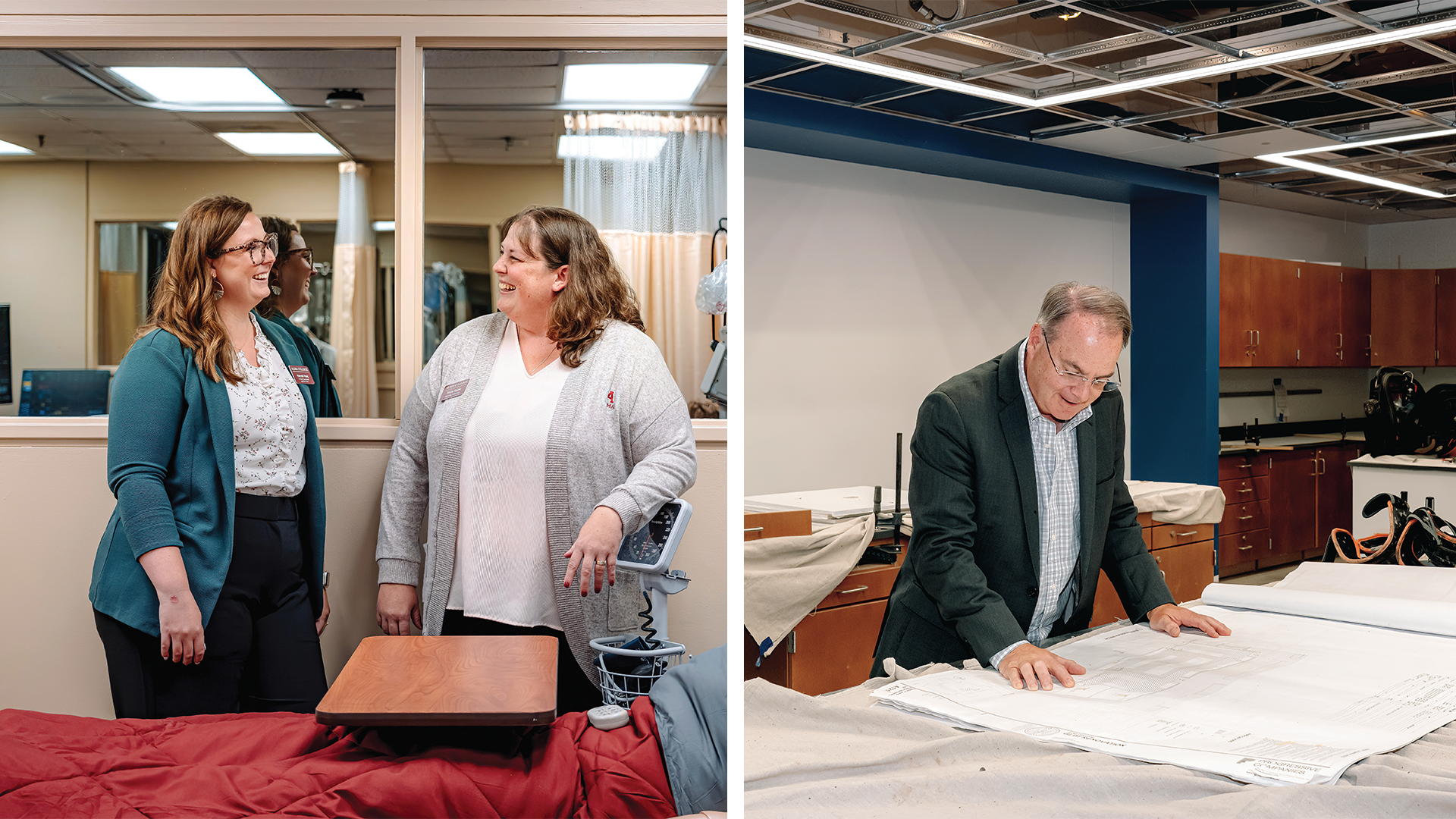
The new nursing lab is located in the lower level of the Swanson Academic Center (SAC). The space simulates a typical environment found in healthcare facilities where nurses may perform tasks. The room houses multiple beds, tools, equipment such as a bladder scanner, EKG monitor, mechanical lifts, white boards, and privacy curtains. It even includes mannequin patients
for students to practice on. The new lab will host three new low-fidelity, non-electronic mannequins and one high-tech patient simulator named Susie, which replicates human responses like breathing, blinking, talking, and blood pressure. Susie
costs approximately $35,000, but it’s a worthwhile investment, because Susie can be programmed to behave and react in various health scenarios. It’s a cutting-edge medical education tool which helps build capability and confidence.
Hannah Hoag, the clinical coordinator and simulation technologist, will be running the lab. She said, It allows students to practice in a safe environment, make mistakes, be corrected in the moment, and not harm somebody. The lab is right here on campus, readily available to them and manned by faculty, whenever they want to hone their skills.
A secondary lab in the Dow Science Center will have two additional low-fidelity mannequins available for practicing techniques.
Previously, students had to go to the MyMichigan Medical Center in Alma for simulation training. Director of Nursing and Chair of the Nursing Department, Alicia Ryder, said, This lab allows us for the first time ever to teach our nursing skills course here on campus. It’s an amazing opportunity.
The larger space will be used for teaching, practice, and testing. It allows more students to actively practice at once.
Nursing Instructor Angela Griffin said, An entire clinical group of eight students can work together.
The lab is surrounded on three sides by one-way glass, stools and a counter, which allows students or instructors to sit behind the glass to observe procedures inside the room and take notes without encroaching on the activities within the lab. A two-way, built-in intercom system allows communication between the two spaces.
Ryder explained, The viewing space allows students to learn from each other, so a student can be doing a simulation and everyone else can be observing. Everybody can talk to each other, and decide if the student is performing appropriately. We can make suggestions. It allows us to pretend to be the doctor or the patient, and interact with the practicing student. It’s a learning opportunity in both directions.
The Alma nursing program partners with the local Masonic Pathways retirement community for three different clinical opportunities. Masonic Pathways has generously donated nearly $100,000 worth of equipment and supplies to help make this lab possible. Alumni donations and the Donald J. (’71) and Dr. Karen S. Yehle Endowed Fund for Nursing also made significant contributions, $5,100 and $7,500 respectively, to build the new lab.
Ryder said, All nursing skill labs will be taught in this space. Students will learn how to insert a catheter, how to give a tube feeding, how to give a bed bath, how to take a blood pressure reading…They’ll get to practice all those skills. They’ll run through simulations with Susie to figure out what’s wrong and treat her appropriately. The main goal is to improve clinical judgement, because the reality is patient care is getting more complicated, so hospital systems are expecting students to come in as brand-new grads, better prepared and ready to do more things right away.
GLWI
Similarly, the new Great Lakes Watershed Institute (GLWI) lab in the Dow Science Center will be a place that better informs, prepares, and inspires science-based action. It’s the first water quality laboratory focused specifically on the watersheds that funnel into and affect the quality of the Great Lakes. This unique and comprehensive initiative will significantly contribute to better understanding, protecting, and restoring watersheds that are vitally important.
Instructor of Geology and Environmental Studies and Senior Department Chair, Murray Borrello, said, The GLWI intentionally connects classroom learning with real-world problems through the work of an environmental lab and partnerships created between two-year educational institutions and local and national entities. Students and faculty use local and regional problems to shape what is taught in the classroom, and in turn, work with organizations and individuals who are trying to address and solve problems that occur in the watersheds.
Developing critical thinking skills, leadership, and stewardship are essential elements in this process.
Borrello said, The GLWI uses a ‘theory-into-practice’ approach of enhanced learning while providing real-world experience for students as they partner with two-year institutions as well as local, regional, and global individuals and organizations focused on improving our environment.
In one instance, Alma College students met with local authorities, collected data, and then created and proposed a hazard remediation plan for Gratiot County government officials to submit.
This new lab is a space dedicated to watershed research and education, but it will be open for multiple departments and even organizations outside of Alma College who are pursuing work related to the watersheds. Business, neuroscience, art and design, communications, and political science are just some studies that intersect. Socio-economic impacts related to degradation of our watersheds feeding the Great Lakes is of considerable interest to the GLWI,
said Borrello. Areas of GLWI research will continue to include geochemistry, toxicology, microbiology, human health studies, economic studies, and ways to improve K-12 science education using data from real-world issues.
Other entities may study the Great Lakes, but our GLWI is different in that it focuses on the health of the Great Lakes (and associated communities) through the lens of the watersheds (the arteries) that feed them,
Borrello said. The health and conditions of the watershed tributaries affects the water quality issues of the Great Lakes. It’s all part of the same living system.
The GLWI lab will work collaboratively with other labs to share physical resources and data. Reaching out to watershed communities to see who could benefit from what the GLWI has to offer is integral to the lab’s purpose.
Through a partnership with the Dow Digital Commons, GLWI research and findings will be made available around the country to municipalities, schools, and non-profit organizations interested in the health of the Great Lakes.
Funding for the GLWI project, totaling about $1.5 million, has come from an Arthur Vining Davis Foundation grant, the Healthy Pine River Group, the Gratiot Community Foundation, a department of education grant, and gifts from alumni and friends of Alma College.
Investing resources in exceptional learning opportunities…it’s an Alma tradition.
Together, these two new labs are opening the door to exceptional learning experiences that will benefit students and positively influence lives far and wide.