
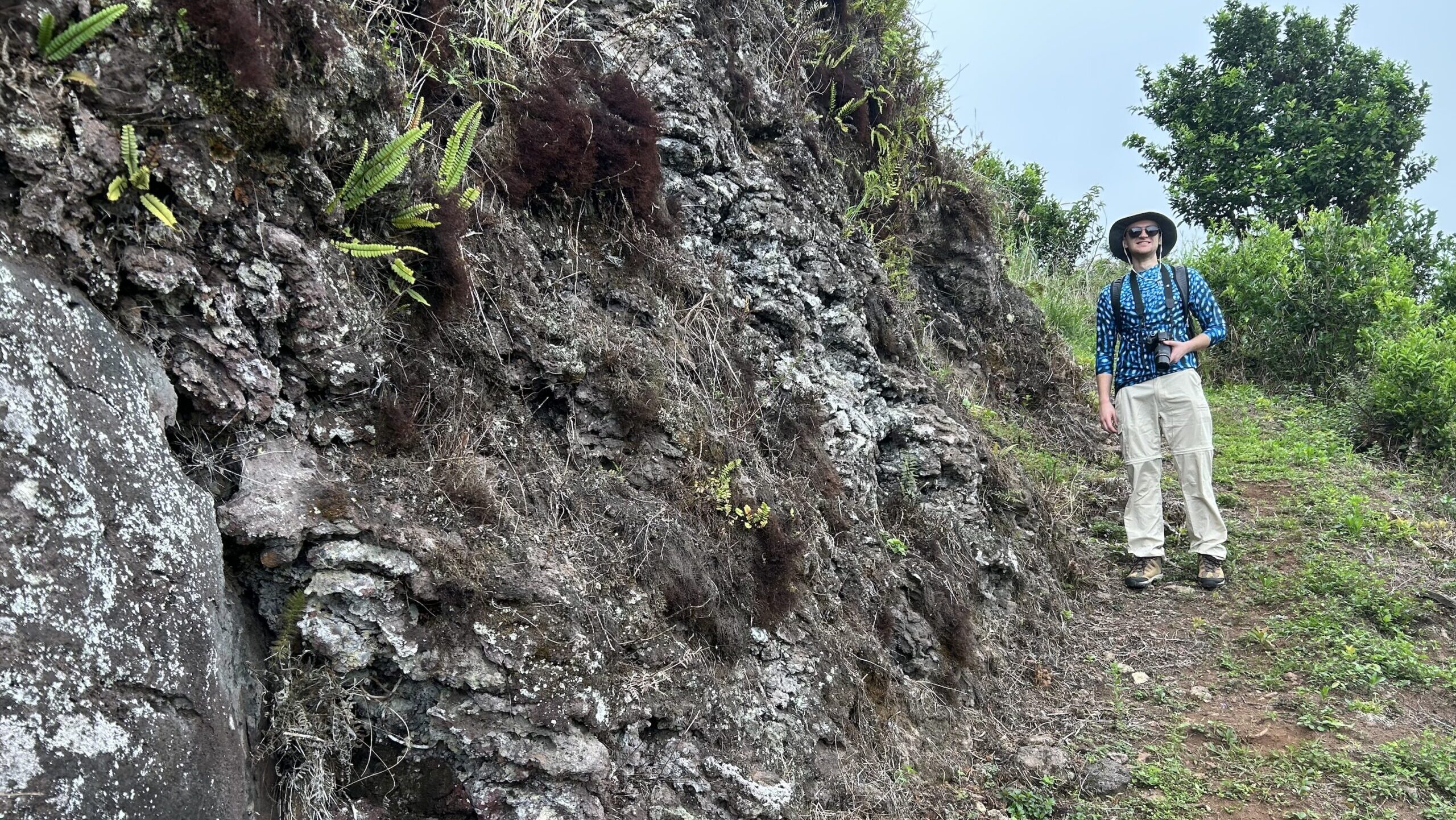
For most students, spring break offers time off. For Michael Fox, it meant 10 days on a remote island in the Galápagos Islands, with the opportunity to conduct research few scientists have ever attempted.
Alongside William R. Angell Professor of Biology John Rowe and retired professor emeritus David Clark, Fox (Alma High School) traveled to Marchena Island — an uninhabited, tightly restricted site — to study a little-known species of lava lizard.
The expedition wasn’t just ambitious. It had the potential to be a missing piece in what has been nearly two decades of research.
Closing the loop
Since 2008, Rowe and Clark have studied lava lizards across mainland Ecuador and the Galápagos, focusing on a specific evolutionary branch known as the eastern clade.
They had already collected data on the mainland species and its close relative on San Cristóbal Island, and their previous findings have been published in academic journals alongside the names of their students. But one species remained unstudied: the population of lava lizards on Marchena Island.
This was the last piece of the puzzle,
Clark said.
By reaching Marchena, the team could complete a rare, full comparison across the entire lineage—allowing them to examine how one ancestral species diverged across dramatically different environments.
Research in a harsh landscape
Marchena is remote, waterless, and rarely visited. The team was among the first permitted to stay there in decades, working under special authorization with collaborators from the University of San Francisco de Quito.
Conditions were extreme: black volcanic sand, intense heat, and no natural water sources.
Within that environment, the researchers focused on three key questions:
- How do the lizards regulate body temperature in extreme heat?
- How do they use space and limited habitat resources?
- How have their behaviors changed compared to mainland relatives?
Using remote monitoring and even robotic models to test behavior, the team was able to gather entirely new data on a species that had seen little to no prior study.
Their work is expected to produce at least two peer-reviewed publications.
A rare undergraduate experience
For Fox, the trip offered something unusual: true, ground-level discovery.
This was brand-new research,
he said. We weren’t repeating known experiments—we were figuring things out in real time.
From tenting in the field to collecting original data, the experience more closely resembled graduate-level work than a typical undergraduate project.
Why it matters
The Marchena expedition didn’t just add another dataset — it completed a scientific story.
By connecting mainland and island species within the same lineage, the research offers new insight into how animals adapt, behave, and survive as they spread into isolated, extreme environments. That work will continue to grow long into the future as Alma College students return to the islands.
It also highlights the kind of hands-on, high-impact opportunities students have the opportunity to have Alma College.
For Rowe, Clark, and their students, the work continues. But for this particular line of inquiry, the journey to Marchena marked a turning point: from years of exploration to a complete, connected understanding.