EDITOR’S NOTE: This story is featured in the Fall 2025 edition of The Tartan magazine. Read more from The Tartan at alma.edu/tartan.
Associate Professor of IPHS Brianna Harfmann ’11 dedicates herself to teaching, advising and service.
Brianna Harfmann ’11 grew up in a family that loved to do jigsaw puzzles together, always with a specific rule that went against the strategic grain: nobody was allowed to sort the edge pieces first.
You had to look for other patterns and start there. It was harder, but more satisfying,
she said.
Harfmann brings a similar mindset to her role as associate professor of Integrative Physiology and Health Science and co-chair of the Pre-Health Professions Committee (PHPC).
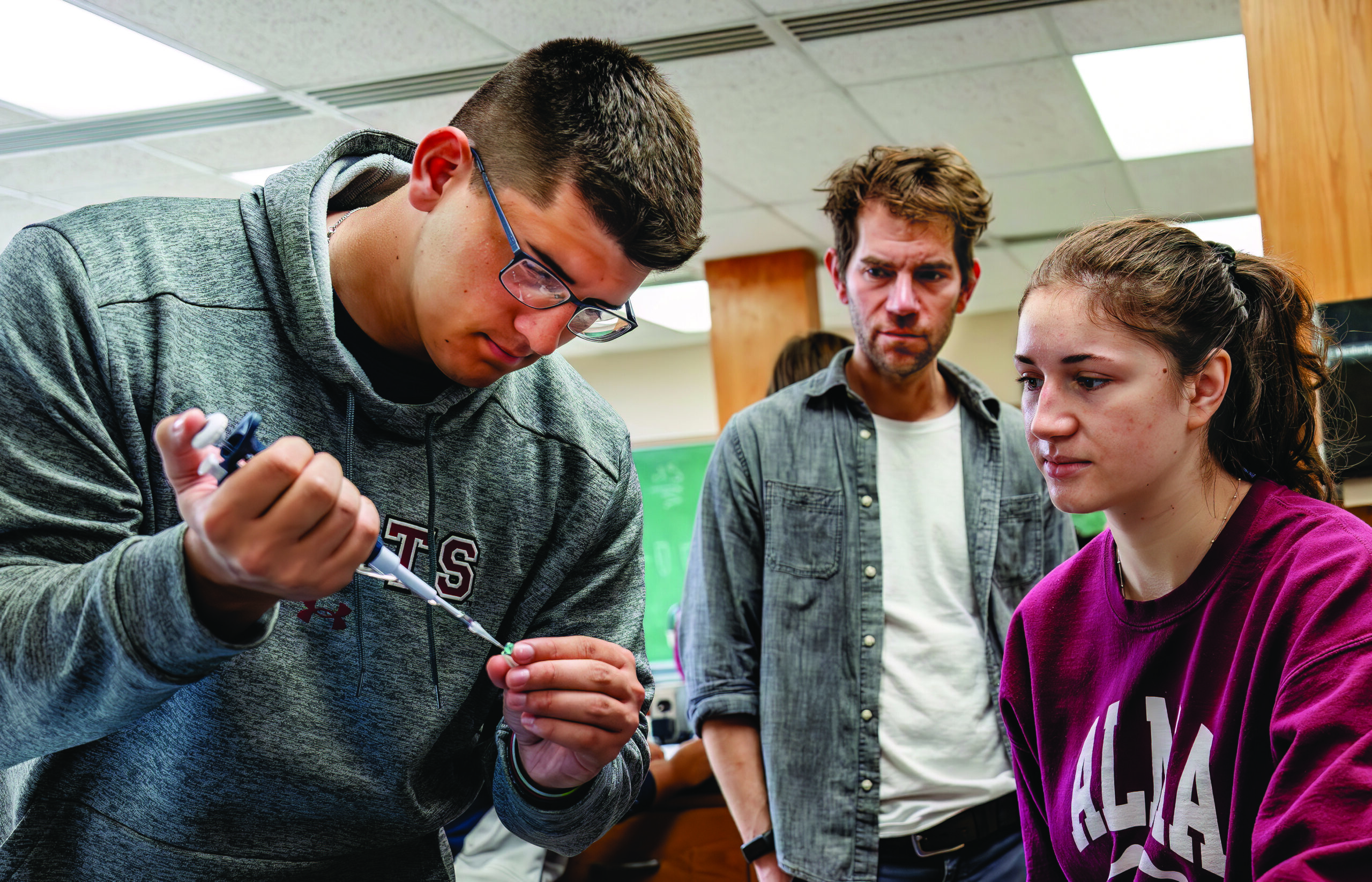
Teaching is a puzzle,
Harfmann said. If a student isn’t grasping something, I have to find a new way to teach it that makes sense to them. It’s about more than the picture that appears at the end. The relationships, the development, the challenge, is part of what I love.
A member of the Class of 2011, Harfmann credits her former professors at Alma — particularly Karen Ball and Maurie Luetkemeier — for inspiring her to pursue a career in teaching over a more research-intensive path.
Dr. Ball taught muscle physiology in such a clear, visual, accessible way,
Harfmann said. When I went to grad school and started interviewing with muscle physiologists, I already had a deeper understanding than they expected, and that was because of her.
Dr. Luetkemeier had this deep, meaningful love of learning. You could walk into his class with no interest in science, and by the end of the day, you’d be hooked. That energy was infectious.
These days, Harfmann’s work at Alma includes a mix of teaching, research, advising, and service. She co-chairs the PHPC with Nancy Dopke, associate professor of chemistry, advising students who are applying to professional programs in medicine, physical therapy and other health-related fields.
I love advising. I like helping students think through their goals and the steps to get there,
Harfmann said.
She and her committee members provide feedback on students’ personal statements, review applications, and conduct 30-minute mock interviews to help prepare for real ones.
The PHPC has also helped facilitate several new articulation agreements with graduate programs, including one signed in 2024 with UM-Flint’s Doctorate of Occupational Therapy program, that make it easier for students to transition into the next step. More articulation agreements are on the way.
We try to make it a thorough and meaningful process, so that students can go into grad school feeling prepared by their time at Alma — in and out of the classroom,
she said.
Harfmann is also a deputy Title IX coordinator, part of a cross-campus team that handles difficult, but essential, civil rights work. We have a great team from across varied divisions of campus,
she said. It’s not easy work, but I feel like I can contribute in a meaningful way.
Harfmann was hired by Alma College in 2017, and even in the span of eight years, she said, the way that students learn and faculty teach has dramatically changed.
Our students went through virtual learning in high school. That shaped the way they learn,
she said. One of my goals is to challenge students while also supporting them. You don’t want to create so much anxiety that they shut down, but you also want to push them outside of their comfort zones so they can grow.
Like many of her colleagues, Harfmann sees herself as a lifelong learner.
We’re always trying to find new ways to explain things, new ways to advise, and new ways to teach,
she said. That’s what makes this work rewarding. You feel like you can reach the whole person. You feel like you really make an impact.